
Decomposing a Vector into Components

In many applications it is necessary to decompose a vector into the sum of two perpendicular vector components. This is true of many physics applications involving force, work and other vector quantities. Perpendicular vectors have a dot product of zero and are called orthogonal vectors.

Figure 1 shows vectors u and v with vector u decomposed into orthogonal components w1 and w2.

Vector u can now be written u = w1 + w2, where w1 is parallel to vector v and w1 is perpendicular/orthogonal to w2. The vector component w1 is also called the projection of vector u onto vector v, projv u.
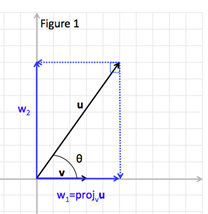
Decomposing a vector into components 1


The projv u can be calculated as follows:

PROJECTION OF U ONTO V:


Let u and v be nonzero vectors:


pro j v  u=[ u·v v 2 ]v


Once the vector component of projv uis found, since u = w1 + w2, component vector w2 can be found by subtracting w1 from u.

w2 = u - w1


Let's look at some examples.

To work these examples requires the use of various vector rules. If you are not familiar with a rule go to the associated topic for a review.


Example 1: Let u=〈-2,2〉 and v=〈3,5〉 . Write vector u as the sum of two orthogonal vectors one of which is a projection of u onto v.

Step 1: Find the projv u.


pro j v u=[ u·v ∥v ∥ 2 ]v= w 1

pro j v u=[ u·v ∥v ∥ 2 ]v


pro j v u=[ ( −2·3 )+( 2·5 ) 3 2 + 5 2 2 ]〈3,5〉


pro j v u=[ −6+10 34 2 ]〈3,5〉


pro j v u=[ 4 34 ]〈3,5〉=[ 2 17 ]〈3,5〉


pro j v u=〈 6 17 , 10 17 〉

Step 2: Find the orthogonal component.


w2 = u - w1

w2 = u - w1


w 2 =〈−2,2〉−〈 6 17 , 10 17 〉


w 2 =〈( −2− 6 17 ), ( 2− 10 17 )〉


w 2 =〈− 40 17 , 24 17 〉

Step 3: Write the vector as the sum of two orthogonal vectors.


u = w1 + w2

u = w1 + w2


u=〈 6 17 , 10 17 〉+〈− 40 17 , 24 17 〉

Example 2: Given vector u=〈1,3〉 and v=〈-4,5〉 , write u as a sum of two orthogonal vectors, one which is a projection of u onto v.

Step 1: Find the projv u.


pro j v u=[ u·v ∥v ∥ 2 ]v= w 1

pro j v u=[ u·v ∥v ∥ 2 ]v


pro j v u=[ ( 1·−4 )+( 3·5 ) ( −4 ) 2 + 5 2 2 ]〈−4,5〉


pro j v u=[ −4+15 41 2 ]〈−4,5〉


pro j v u=[ 11 41 ]〈−4,5〉


pro j v u=〈− 44 41 , 55 41 〉

Step 2: Find the orthogonal component.


w2 = u - w1

w2 = u - w1


w 2 =〈1,3〉−〈− 44 41 , 55 41 〉


w 2 =〈( 1+ 44 41 ), ( 3− 55 41 )〉


w 2 =〈 85 41 , 68 41 〉

Step 3: Write the vector as the sum of two orthogonal vectors.


u = w1 + w2

u = w1 + w2


u=〈− 44 41 , 55 41 〉+〈 85 41 , 68 41 〉


Related Links:
Math
algebra
The First Derivative Rule
The Second Derivative Rule
Algebra Topics


To link to this Decomposing a Vector into Components page, copy the following code to your site:


Educational Videos